Medical Caduceus Icon Set
A Designer’s First Look: Clean, Calm, and Purposefully Minimal
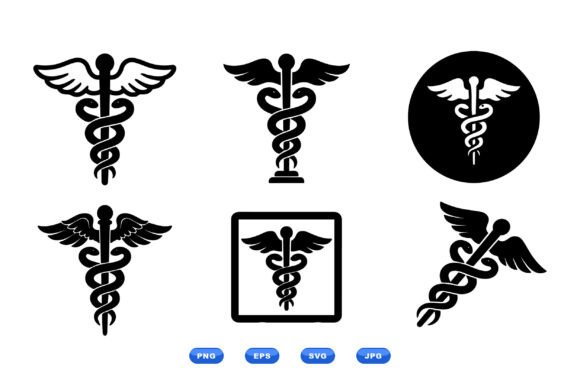
Opening the ZIP for the Medical Caduceus Icon Set, I felt immediate relief — no cluttered previews, no overdesigned variants. Just six crisp black caduceus icons in flat minimalist vector form, each with thoughtful variation in layout and shape. They don’t shout; they settle. That calm tone is rare in medical-themed graphics, where heavy symbolism often leans into urgency or clinical sterility. These icons breathe space. As an embroidery designer who’s stitched everything from NICU onesies to boutique clinic aprons, I knew right away: this set belongs on quiet, intentional pieces — not mass-printed t-shirts, but embroidered baby blankets, linen tea towels for holistic practitioners, or subtle chest patches on organic cotton lab coats.
Stitching It Out: Where This Set Truly Shines
I tested one icon — the centered vertical caduceus with balanced serpents and wings — on a medium-weight cotton tote bag using 40-weight polyester thread and tear-away + cut-away stabilizer. The result? Crisp edges, zero distortion, and a refined presence that read clearly at 2.5 inches tall. That’s the sweet spot: 2–3 inches works beautifully across custom apparel, embroidered patch backings, and pillow cover accents. On a soft-brimmed cap, I scaled it down to 1.75 inches — still legible, though the inner wing details softened slightly (as expected on curved surfaces). For baby embroidery, I’d choose the simplest layout — no overlapping serpents, no tight negative space — and pair it with gentle satin stitch outlines and low-density fill. It reads as caring, not clinical.
This set excels in personalized gift contexts: a lavender linen kitchen towel for a nurse’s retirement, a cream-colored sweatshirt for a med student’s graduation, or a monogrammed nursery pillow with a tiny caduceus tucked beneath the initials. Because the icons are purely black vector art — no gradients, no shadows — they translate cleanly into single-color embroidery files. No need to wrestle with color breaks or underlay complications. That simplicity saves time when prepping for commercial embroidery runs or batch-producing Etsy seller listings.
Where to Pause — Real Fabric Realities
Don’t rush this onto thin or stretchy fabric without testing. I tried the most detailed icon (with interwoven serpents and fine wing filigree) on lightweight jersey — even with heavy stabilizer, the inner curves blurred slightly after washing. For tote bag design or sweatshirt embroidery, stick to stable weaves: midweight cotton, twill, canvas, or linen blends. On dark fabric, the black-on-black effect is elegant but risks disappearing — always test with contrasting thread (charcoal gray or deep navy) if clarity matters more than strict monochrome branding.
The Medical Caduceus Icon Set isn’t built for micro-embroidery. Below 1.25 inches, the serpent heads and wing tips lose definition, especially in dense fill stitch areas. Avoid cramming it into tiny hoops (hoop size under 3 inches) unless you’re simplifying the vector first. And skip textured surfaces like bouclé or heavily napped fleece — the clean lines get lost. For holiday embroidery or wedding gifts (think “Dr. & Dr.” linen napkins), pair it with delicate running stitch borders instead of trying to force complexity.
What It Adds — and What It Doesn’t Pretend To Be
This isn’t a flashy, attention-grabbing emblem. It doesn’t scream “ER” or “EMT.” It whispers “care,” “balance,” “intention.” That subtlety elevates handmade product perception — customers notice craftsmanship, not just content. A boutique selling herbalist aprons or midwife welcome kits gains instant cohesion with these icons. They support brand consistency without overwhelming; they reinforce professionalism without coldness. In Etsy mockups, the black vector renders flawlessly in both light and dark background previews — crucial for printable mockup accuracy and buyer confidence.
It also avoids common pitfalls: no tiny lettering to digitize, no layered elements requiring appliqué design sequencing, no fragile stems or floating serpents that snag during trimming. That means fewer re-stitches, less thread breakage, and smoother transitions between digital embroidery file prep and final finished product.
Practical Notes Every Embroiderer Should Check
- Test first — Stitch your chosen icon on scrap fabric matching your final project’s weight and stretch.
- Review stitch density — Especially in serpent coils and wing interiors; adjust if your machine hesitates or fabric puckers.
- Confirm licensing — Since this is a Graphics product sold as a Crafts-category digital asset, verify whether commercial use (e.g., selling embroidered totes on Etsy) is permitted before launching your craft business line.
- Check contrast — Run black-and-white mockups to see how the icon holds up on light vs. dark substrates.
- Use proper stabilizer — Medium-weight cut-away works best for most custom apparel; add tear-away for lighter fabrics.
- Inspect small details — Zoom in on vector files before digitizing — ensure serpents don’t unintentionally merge or clip at the staff base.
- Consider thread colors — While black reads cleanly, charcoal, deep green, or soft gray can soften the tone for pediatric or wellness-focused small shop product lines.
Final Thought: Quiet Confidence, Not Quick Decoration
The Medical Caduceus Icon Set won’t win awards for flashiness — and it shouldn’t. Its strength is restraint. It respects the weight of its symbolism while leaving room for warmth, humanity, and handmade care. Whether you’re stitching a personalized gift for a retiring physician or building a cohesive digital product suite for wellness brands, this set delivers clean, usable, emotionally intelligent design assets. It doesn’t distract — it dignifies. And in embroidery, where every stitch carries intention, that’s exactly what makes a design worth keeping.